01 /
Choose the problem before choosing the board.
A good advanced purchase begins with a sentence you can test: “I want earlier entry without losing control in this wave,” or “My current board feels reluctant to change rails when the surf is weak.” “I want a magic board” is understandable, but gives a shaper very little to work with.
Bring a known reference: the board you ride most, its dimensions and construction, your fins, your weight, the waves you actually surf and the things you like or dislike. Include your frequency of surfing and normal paddle endurance. A fit that works on a two-week surf trip may be demanding when you return after a month out of the water.
Separate three decisions. Family describes the board’s overall approach: log, egg, fish, groveler and so on. Fin system describes the arrangement beneath it. Construction describes its core, skin, reinforcement and resulting structural behavior. A quad can be a fish, a shortboard or a longboard. A twinzer can span several families. None of these words is a complete specification.
The detailed features below are interacting design choices. Ride tendencies are not guarantees. Speed, wave shape, surfer input, fin choice and the placement of a contour all affect the result. Use the surfboard size calculator as a starting envelope, then use this guide to decide what belongs inside it.
02 /
The hands-on test: thumb below, fingers above.
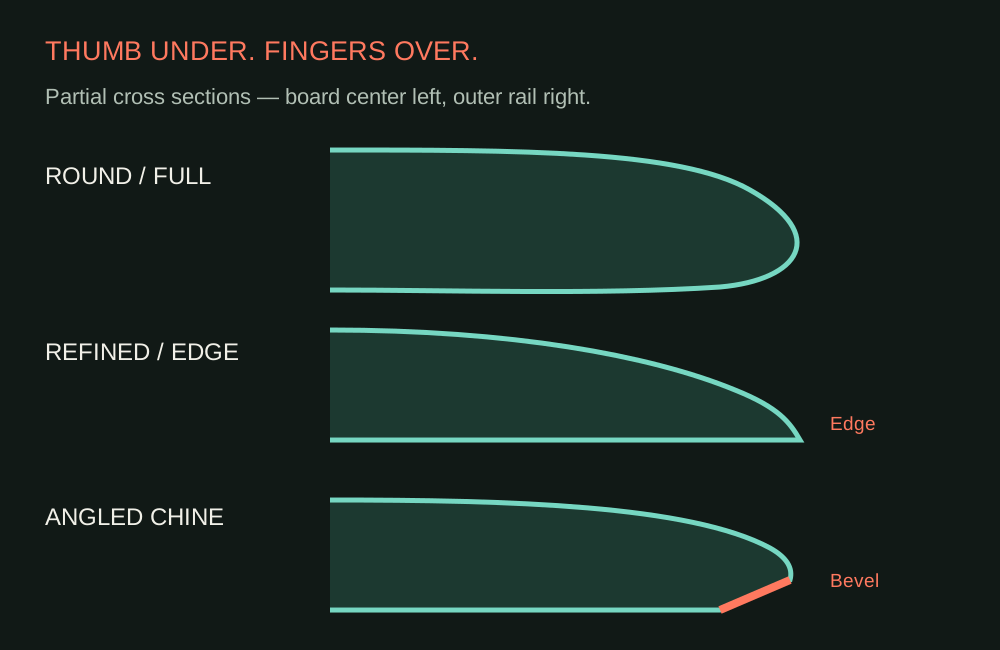
Peter’s favorite starting check is wonderfully direct: hold the rail gently with your thumb on the bottom and your fingers on the deck. Your hand spans the cross section. It makes the rail’s volume, apex, deck crown, tuck and edge easier to understand than a photograph or a dimension sticker.
- Start near the wide point. Feel whether the rail fills your hand or tapers away. Notice where the deck starts to fall toward the rail.
- Move forward. Compare the shoulder and nose area. Ask how much rail volume remains ahead of your front foot.
- Move aft. Follow the changing profile toward the rear foot and fins. Notice where an edge becomes firmer, where thickness disappears and how much tail remains under your hand.
- Compare with a known board. Repeat at roughly corresponding positions. Your own reference turns an unfamiliar sensation into a meaningful difference.
Support the board securely. Use the pads of your fingers, not your nails, and do not squeeze or flex it as a test. Ask before handling a shop board, placing it on a rail or bringing a straightedge near its finish.
Next, lift it normally and notice the weight and its distribution. A board can feel light overall yet carry substantial mass toward the ends. Your impression is useful, but hand feel is not a measurement of flex or proof of on-wave performance. Dry balance also changes once water, rider and fins load the board.
Experienced surfers build this intuition by repeatedly connecting shapes with sessions. You can accelerate that learning: say what you notice out loud, predict what may change, then check that prediction in the water. “This tail feels finer than mine” is a better starting observation than “This one is definitely faster.”
03 /
Liters, foil and the location of the foam.
Liters express volume. They do not tell you where the foam is, how the outline carries it or how much of the rail you must engage. A high-volume center can coexist with a relatively refined perimeter. Two equal-volume boards can differ dramatically under your arm and under your feet.
Foil is the distribution of thickness, both along the board and across it. Consider the chest area, front-foot platform, tail thickness and rail volume separately. More material under the chest may help achieve a useful paddling posture without making the tail equally thick. A crowned deck can preserve central thickness while reducing rail bulk; a flatter deck carries more of its thickness outward.
Volume relative to body weight is a convenient comparison, not a complete prescription. Surf Simply explains why maximum length, width and thickness cannot uniquely determine liters.[1] Do not reverse-engineer an exact volume for an older board from those three dimensions and present the result as measured fact.
Three useful design examples.
Haydenshapes Holy Grail: the verified model is Hayden’s, not a Mayhem or Machado design. Haydenshapes describes chest-area volume and a performance-oriented approach; it explicitly does not position the model as a beginner board. More help catching waves is not the same as beginner forgiveness.[2]
…Lost / Mayhem Hydra: Matt Biolos combines a broad small-wave platform with a particular concave, chine and tail package. It illustrates why “a lot of foam” is only the beginning of the description.[3]
Rob Machado’s Machadocado: Firewire describes a compact, full design with a refined tail and a double-concave/vee arrangement. It is an example of distributing foam while managing the transition into turns, not evidence that every short, high-volume shape suits a learner.[4]
These are design references, not a ranking or a claim that we have personally tested each model. Compare the actual size and construction you would buy. A model name can cover a substantial range of dimensions.
04 /
Outline, wide point, nose and tail.
Stand the board safely or look straight down its length with it supported. Follow the outline without being distracted by the paint. Where is it broadest? How much area lies ahead of your front foot and behind your rear foot? Does the curve remain full into the tail, or pull in quickly?
A fuller front half can offer useful area for paddling and trim. A pulled-in nose reduces area and mass at that end but also changes the platform available on late entry. A wide tail offers a substantial planing area in weaker waves; a narrower tail can be easier to control when the wave supplies plenty of speed. These are comparisons within otherwise sensible designs, not rules that override rocker, rails or fins.
Wide-point position changes the balance of the outline relative to your stance. A forward wide point, an even curve and a wide point farther aft can each suit different approaches. Ask where the designer expects you to stand and how far you need to move to turn the board well.
| Tail treatment | Useful design idea | What to compare in person |
|---|---|---|
| Square / squash | Carries area behind the rear foot, with corners shaped to suit release and turning. | Actual width, corner shape and thickness; two squash tails can be very different. |
| Round / rounded pin | A continuous outline into a progressively narrower rear platform. | How soon it pulls in, and how much area remains under your back foot. |
| Pin | Strongly reduced tail area for a specialized control brief. | The whole big-wave or powerful-wave design; a pin alone does not make a board appropriate. |
| Swallow | Keeps two tail tips while removing material between them. | Overall width, depth of the cut and fin placement. A broad fish swallow is not a narrow performance swallow. |
| Diamond / split diamond | Changes the rear outline and corners while retaining selected area. | Where the working rail ends relative to your foot and the fins. |
Tail labels are shorthand. Trace the last third of the rail and compare area, thickness and rocker together. Protect swallow tips and sharp corners during transport; their vulnerability is a practical ownership consideration as well as a design detail.
05 /
Nose, middle and tail rocker.
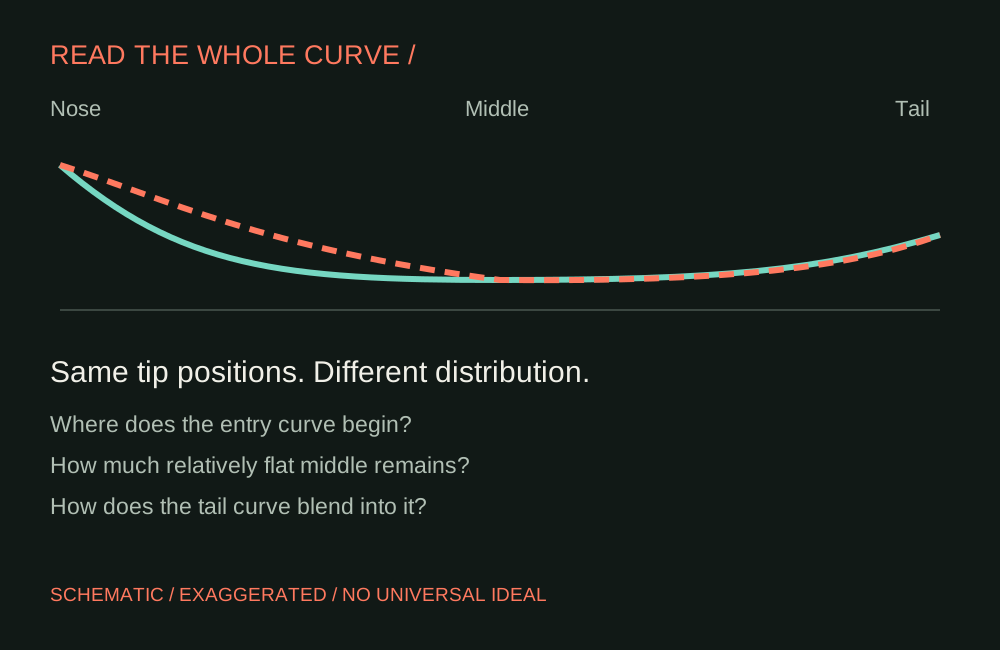
Rocker is the lengthwise curve. Bottom rocker, deck rocker and rail rocker describe different paths; bottom contours can make the centerline and rail paths differ. Thickness distribution lies between deck and bottom. Read the entire curve, not only the upturned tips.[5]
A relatively relaxed entry and middle can suit carrying speed in weak waves. More curve can suit tighter transitions and steeper wave shapes, but the location and blend matter. Tail rocker influences how the rear portion fits into a turn. A smooth continuous rocker need not be a single constant-radius arc; a staged design may deliberately retain a flatter section between more curved ends.
How to inspect it.
Support the board and sight it side-on at eye level. First look at the whole bottom line. Then isolate entry, middle and exit. Ask where the curve starts to increase, how long the relatively straight area is, and whether the tail lift begins gradually or concentrates near the end. Compare against a familiar board in the same orientation.
Equal nose-tip lift does not imply equal entry rocker. One board may carry more curve farther back while another has a late nose flip. The same is true at the tail. Do not compare two isolated tip measurements and assume the boards will paddle or turn alike.
Relate the observation to a real complaint. If a board feels excellent once moving but hard to get into weak waves, ask about its entry, middle curve, outline and your paddling trim together. If it resists fitting a tight pocket, ask about its length, rail line, tail curve and stance. A nose catching can involve positioning or takeoff timing as well as board design. Buying more nose rocker is not a universal cure for pearling.
06 /
Flat, belly, vee, single and double concaves.
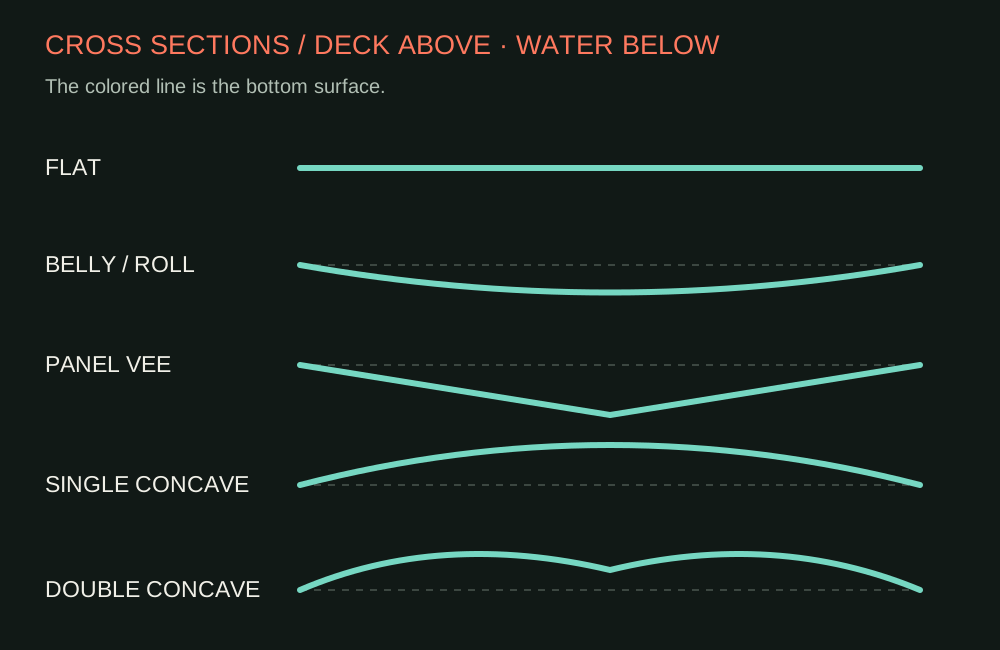
Read a bottom both lengthwise and across its width. “Flat bottom” usually describes a cross section; the same board can still have substantial nose-to-tail rocker. Most modern designs blend several cross sections along the board.
| Contour | What it is | Questions worth asking |
|---|---|---|
| Flat | A relatively straight cross section from side to side. | Where does it start and finish? How does it combine with width, rocker and edge? |
| Belly / roll | A smoothly convex cross section, with the center projecting toward the water. | How much roll, and through which part of the board? |
| Panel vee | Two relatively planar panels meeting at a centerline that projects toward the water. | Is it entry vee, tail vee, or a longer transition? How does it blend into adjacent contours? |
| Single concave | One broad hollow across the bottom. | How deep is it, where is its maximum, and how does it exit? |
| Double concave | Two hollows separated by a center ridge. | Is the double inside an overall single, or combined with vee? What happens at the fins? |
| Channels | More defined grooves or panels, often concentrated aft. | Is the whole fin/bottom package designed around them? What are the repair and handling implications? |
Vee and roll are often used to shape how a board banks from one side to the other. Concaves change the bottom surface and its relationship to the rail rocker. A double can sit within a single, so those names are not mutually exclusive.[6] Placement and depth are essential parts of the description.
Greenlight’s design guide describes mixtures of bottom features and their intended riding characteristics.[7] In practical buying terms, ask whether the combination is intended to feel settled, direct, lively, easy to bank or more connected at speed. Then ask what kind of wave and rider input that intention assumes.
What is physically changing?
A moving board is supported by buoyancy and dynamic water forces. Pressure and friction act across its wetted surfaces; their total and distribution affect support, resistance and the moments that pitch, roll and turn the board. Changing a contour changes which surfaces meet the flow, at what angle, and how that changes as you lean.
With vee, banking brings one inclined panel toward a different relationship with the local water surface. A concave changes the cross section and, depending on how it is shaped, the relationship between center and rail rocker. A double introduces two hollows and another transition between the sides. These are geometric reasons the board can feel different; they do not specify the size or direction of every force throughout a turn.
A published CFD comparison of three surfboard designs found that a rocker change increased both lift and drag in the cases studied. It illustrates a useful tradeoff: more of one desirable force is not automatically a faster or better board. The result belongs to those simulated designs and conditions, not every board in breaking surf.[16]
A double concave is not twice the lift of a single, and deeper is not automatically faster. Water flow around a surfing board changes with speed, trim, immersion, the wave and the turn. Attractive explanations about water being compressed like a jet engine are not a substitute for evidence. Treat a designer’s intended feel as useful context, then test it.
Make the contour visible.
Use low, angled light and sight along the bottom. If the owner permits, lay a clean, non-marking straightedge lightly across several positions. A gap beneath the middle suggests a concavity relative to that reference. Center contact with gaps outward suggests vee or roll. A double may show two hollows. Do not slide a gritty ruler across a finish, bridge delicate fins or press to flatten the board.
Map the transitions: nose, chest, front foot, rear foot, fin cluster and tail. “Single to double to vee” becomes meaningful only when you know where each occurs and how strongly it is expressed. Compare the pattern with a board you know; even then, expect the fins and rails to change the final experience.
07 /
Rails: volume, apex, tuck and release.
The rail is a changing three-dimensional edge, not one profile repeated from nose to tail. Its outermost point is the apex. Labels such as 50/50 or 60/40 describe an approximate profile convention; they do not specify the rail’s volume, tuck, edge or longitudinal transition. A downrail places the apex lower than a symmetrical round rail.[8]
Use your hand to separate four observations: how full it is, where its apex sits, how it turns under, and whether there is a defined edge. A full rail generally takes more loading to immerse than a refined rail, but loading depends on the surfer, speed and the whole board. “Soft” can describe a rounded shape; it does not mean the construction itself is soft.
Full and boxy versus refined.
A fuller perimeter can support weight through a weaker section, yet may feel difficult to engage for a lighter surfer. A finer rail can feel sensitive and precise under appropriate loading, yet may be unforgiving if you overload it at low speed. Neither category is automatically advanced, and neither can be selected from liters alone.
Round transitions versus a hard edge.
A rounded lower transition and an abrupt bottom-to-rail corner interact with the water differently. Many boards develop a more defined edge toward the tail while keeping the forward area more rounded. Look for where that change happens. Compare the rail under the front foot with the rail around the fins; calling the whole board “hard-railed” may conceal the important distinction.
Do not infer grip from one detail. A surfer who says a board will not hold may be describing fins, stance, rail loading, tail area or conditions. A board that feels sticky in transitions may have a different combination of those factors. Explain the sensation and the phase of the turn to a shaper before diagnosing a single contour.
08 /
Beveled and chamfered rails: what changes?
A bevel or chamfer removes a corner to create an angled surface. A chine is a discernible transition between surfaces. Shapers use these words somewhat differently, so ask to see the actual feature. A smooth tucked-under rail is not necessarily the same thing as a distinct planar bevel.
These features can let a designer keep a broad central platform while changing the perimeter’s relationship to the water and the way the board moves onto a rail. Their effect depends on width, angle, depth, location and the rest of the bottom. They are not a universal cure for a wide board that feels hard to turn.
The …Lost Hydra is a concrete example: its maker describes chines as part of a package intended to help a broad, low-rockered small-wave board transition between rails. The single/double bottom and split-diamond tail belong to that same package.[3] Treat the explanation as the designer’s brief, not a controlled comparison proving that a bevel alone delivers the result.
Hold the rail and follow the angled surface toward both ends. Does it run along much of the board or fade out? Is it easy to feel, or almost invisible? Compare the remaining rail thickness. When buying used, inspect these changes of plane carefully: a repair that alters the edge can change the shape you are paying for.
09 /
See the typical board shapes.
Compare plain renderings traced from real board references, identified below. Equal display height makes the outlines easier to compare; actual board lengths vary. These are reference examples, not family averages, size prescriptions or shaping templates. The finish is illustrative. Designers blend these families and use many different tails.
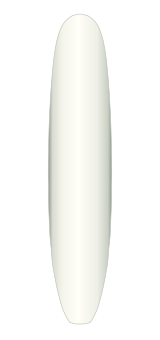
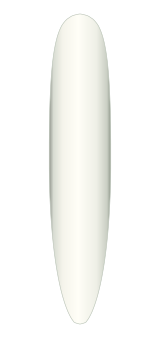
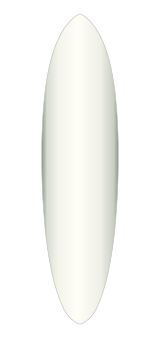
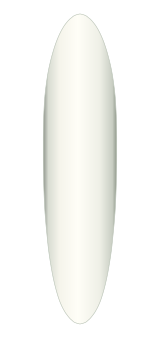
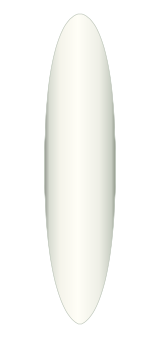
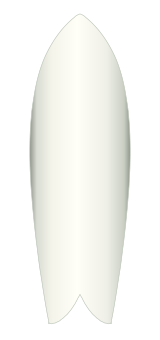
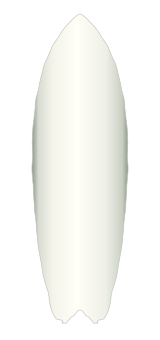
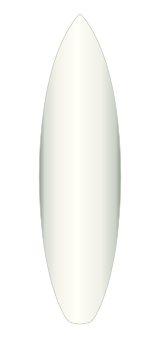
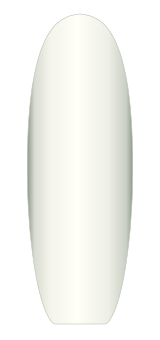
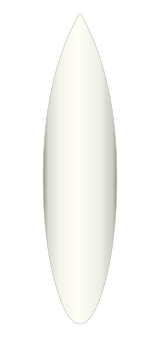
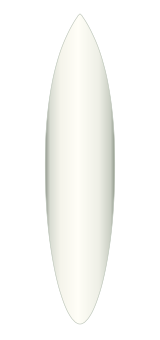
Open the full board-shape comparison graphic ↗
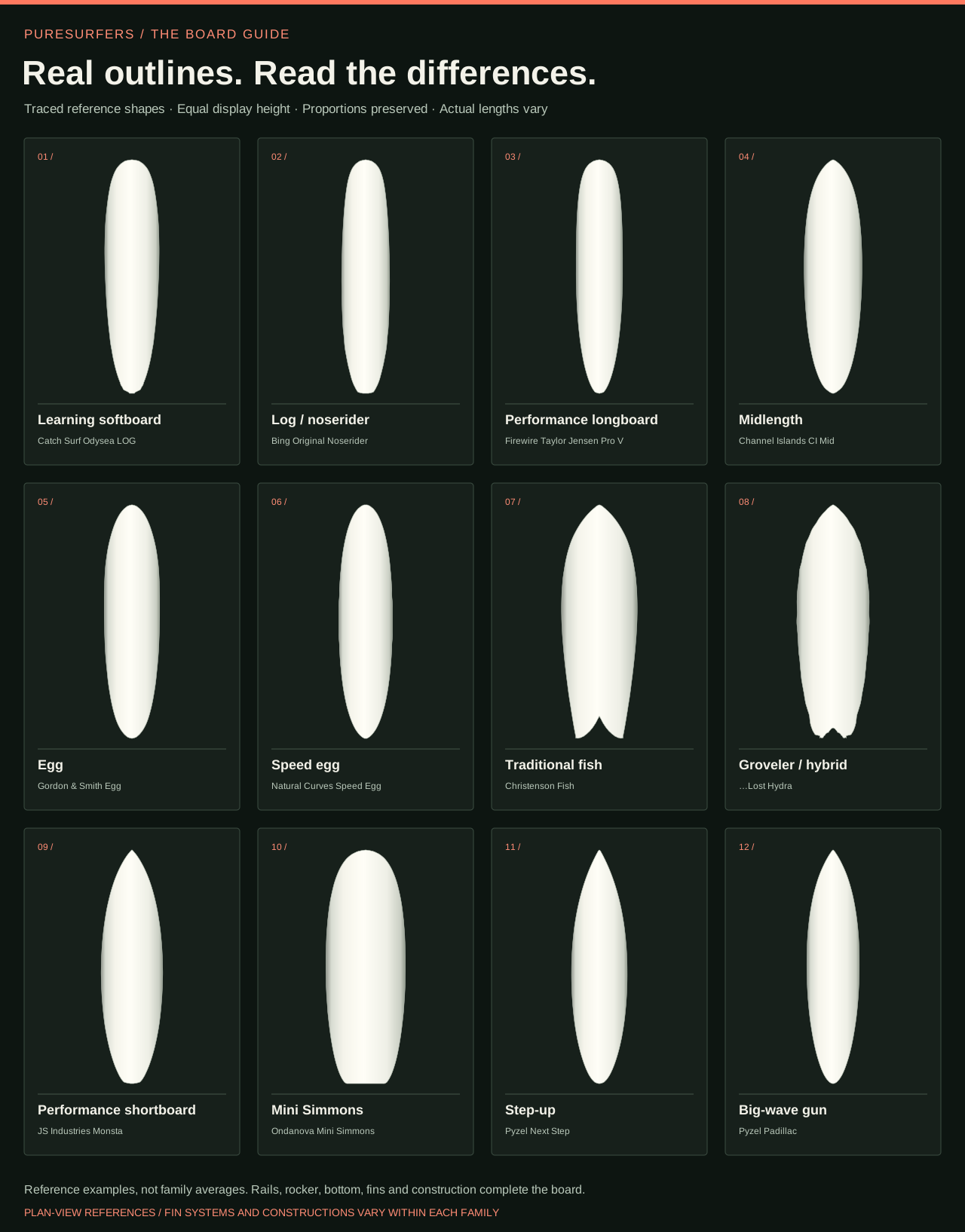
Single, twin, thruster, quad, twinzer and Bonzer describe fin or coordinated bottom-and-fin systems, not one unique outline. A board’s rocker, rails and bottom are also invisible in this top view.
10 /
The board families, and where they shine.
Use these as design briefs, not rigid categories. Local shapers often blend them, and naming is not standardized. Start with the feeling and conditions you want, then examine the actual board.
Traditional logs and noseriders.
A traditional log favors trim, deliberate footwork and the pleasure of carrying a line. A noserider organizes its outline, rocker, bottom and fin choice around controlled positioning toward the nose in suitable waves. Some designs overlap heavily. The board does not “nose ride itself”: pocket position, speed and technique remain decisive. Weight can contribute to a settled, flowing feel while making carrying and quick redirection more demanding.
Performance longboards.
These pursue more responsive turning while retaining a longboard platform. They often use a more refined tail, different rocker and a fin arrangement suited to that brief. They can be a good choice for surfers who love wave catching and length but want a more active approach. Do not assume one board will match a specialized log’s feel and a specialized shortboard’s response equally well.
Midlengths, eggs and speed eggs.
Midlength is a broad size category, not a promise of beginner ease. An egg commonly has a rounded, flowing outline and can support relaxed trim and connected turns. A speed egg usually pulls the design toward more directed, faster surfing, but the term has no single specification. Longer rail lines can feel wonderful on a running wave and require different positioning in a tight pocket. Almond’s midlength discussion is useful for understanding these boards as their own surfing choice rather than merely a transitional purchase.[9]
Fish.
A traditional fish combines a short, broad platform with a fish-like outline and swallow tail, often with twin keels. Modern fish range widely and may use twins, quads or other setups. Many reward flow, a useful line and speed carried across softer sections; some are designed for considerably more powerful waves. Ask whether the particular board favors drawn-out drive, tighter redirection or a compromise. Width and foam do not automatically make a short fish easy for a beginner.
Grovelers and hybrids.
A groveler puts weak-wave usefulness high in the brief: enough platform, suitable rocker and accessible speed in conditions that leave a demanding performance board feeling flat. “Hybrid” means a blend, so ask which ideas were blended and why. An oversized performance shortboard and a purpose-designed groveler can contain the same liters while solving the weak-wave problem differently.
High-performance shortboards.
These prioritize precise, responsive surfing under an intended combination of rider input and wave quality. They commonly require the surfer to generate and manage speed actively. For a skilled surfer in suitable surf, that sensitivity is the attraction. In weak waves or under an infrequent surfer, it can become unnecessary work. The right size is not always the smallest volume you can paddle.
Mini Simmons.
A mini Simmons is a compact, broad design associated with a substantial planing platform and a distinctive fast, flowing feel. Interpretations vary in rails, bottom, tail and fins. The width changes how you load and move the board, so it is particularly valuable to try one rather than assume a familiar shortboard technique will translate unchanged.
Step-ups, semi-guns and guns.
A step-up extends a surfer’s familiar range toward more powerful conditions; it is not simply any shortboard bought two inches longer. More specialized semi-guns and guns address increasingly demanding entry, speed and control requirements. Discuss the actual break and your experience with a qualified local shaper. A size calculator for ordinary board shopping is not a big-wave equipment prescription.
Asymmetrical and specialized designs.
Some boards deliberately use different heel-side and toe-side geometry or fin placement. They deserve evaluation as an integrated design, with stance and intended use understood. An unusual silhouette is neither proof of innovation nor evidence of a defect. Ask what the difference is intended to accomplish and what comparison the shaper recommends.
11 /
Single, twin, thruster, quad, Bonzer and twinzer.
Fin layout works with the board rather than replacing its design. Our full fin guide covers fit, construction and compatibility. Here the question is which system belongs in the board-selection conversation.
| System | Basic arrangement | What to discuss or demo |
|---|---|---|
| Single | One principal fin. | Trim, line choice and the effect of its position in an adjustable box; template and board matter. |
| 2+1 | A larger center fin with smaller sidebites. | The balance between center-fin feel and added side-fin influence on an egg, mid or longboard. |
| Twin | Two principal side fins. | Keel versus more upright templates, drive, release and how the tail is intended to be loaded. |
| Twin + trailer | Twin mains with a smaller center stabilizer. | Whether the board and boxes were designed for it; the trailer is a tuning choice, not a free upgrade. |
| Thruster | Two side fins and a center fin of broadly comparable scale. | A familiar reference for balancing drive, hold and controlled release across many shapes. |
| Quad | Four fins arranged in side pairs. | Rear-fin placement and size, how it feels on a line and during transitions; quads do not all feel alike. |
Bonzer: an integrated bottom-and-fin design.
The Campbell brothers’ Bonzer combines a coordinated bottom with side runners and a center fin. Three-fin and five-fin versions are distinct arrangements within that system; they are not ordinary thruster and quad options with a different name. Campbell’s own comparison stresses that the underlying board template still matters.[10][11] Consider one if connected, driving rail surfing interests you, and try the intended setup before tuning it. Generic fins in generic boxes do not recreate the package.
Twinzer: small canards ahead of the main fins.
A twinzer places smaller forward fins in relation to larger main fins behind them. Position and pairing are central to the idea; it is not simply a conventional quad with arbitrary small front fins. Stu Kenson describes a coordinated canard-and-main-fin set, while Vince Broglio’s designs show the layout across several board families.[12][13] Ask about the matching fins and box placement, and budget for the correct set.
Five boxes usually offer alternative configurations, not permission to fill them all. A Bonzer 5 is an intentional exception, not evidence that five ordinary shortboard fins are a good default. Confirm the intended setup with the shaper and change one variable at a time.
12 /
Core, resin, glass, carbon and wood.
Ask for the complete construction rather than accepting one material as the whole answer. The core, laminate, reinforcement placement, resin, skins and stringers combine to determine weight, stiffness, flex, damping, durability and repair needs. Finish and branding can conceal very different builds.
PU/polyester and PU/epoxy.
PU is polyurethane foam. It can be glassed with an appropriate polyester or epoxy system. A familiar PU/polyester board can be an excellent reference for a surfer who knows that feel, but “poly” is not a specification for its glass schedule or strength. Ask how much reinforcement is on deck and bottom and whether the build is intended for everyday durability or minimum weight.
EPS/epoxy.
EPS is expanded polystyrene foam and requires compatible epoxy lamination; ordinary polyester resin can damage the core.[14] EPS/epoxy boards can be built in many weights and structures. Compare like-for-like designs before attributing every sensation to the foam. Liters describe external volume; a board does not gain a new volume simply because the resin changed.
Carbon fiber and composite skins.
Carbon is a reinforcement that can be placed in strips, rails, patches or broader laminates. Fiber direction, placement, resin and the rest of the structure matter more than the mere presence of black cloth. Ask what movement the reinforcement is intended to control and how that suits your weight and waves. “Carbon” is not a guarantee of better flex, impact resistance or an easier repair.
A very light, responsive construction may appeal in one setting and feel less settled to a particular surfer in another. A heavier build can have practical and riding benefits too. Those are reasons to compare constructions of a familiar shape, not universal rankings of one material over another.
Wood, balsa and sandwich structures.
A wood-looking board might be solid or chambered wood, a hollow structure, a foam core with wood veneer, or a composite with wood rails. Ask which. Balsa and other woods may be structural elements rather than a decorative skin. Firewire’s description of Helium construction, for example, combines an EPS core, wood rails and deck skins; that differs from a conventional central-stringer build.[4]
Evaluate the complete weight, finish, maintenance and repair route. Wood is not automatically fragile or indestructible, and a veneer does not identify what lies beneath it. If environmental claims influence your purchase, look for a specific, documented claim about that construction rather than assuming any natural-looking surface establishes a low overall impact.
13 /
Glassing schedules: performance, pressure dents and longevity.
The same shape can be built for different priorities. A surfer buying a durable daily board and a team rider choosing a highly weight-sensitive competition board may want different laminates. Ask how the board is glassed before treating its low weight as an advantage. Less reinforcement can change weight and flex while leaving less margin for routine knocks and concentrated foot pressure.
Read the cloth weight and the whole schedule.
“4 oz” and “6 oz” are nominal dry-fabric weights per square yard; they do not describe finished laminate thickness, resin quantity or whole-board weight.[17] In the shorthand below, the deck is before the slash and the bottom after it. Suppliers may write schedules differently, so confirm the meaning.
| Example schedule | What the shorthand means | What to clarify |
|---|---|---|
| 4 / 4 | One full nominal 4 oz deck layer and one full 4 oz bottom layer. | A minimal conventional layup: ask about intended rider, core, cloth type and expected wear. |
| 4 + 4 / 4 | Two full 4 oz deck layers and one full 4 oz bottom layer. | Eight nominal ounces of dry cloth per square yard on the deck before overlaps—not an eight-ounce finished board. |
| 4 + ¾ patch of 4 / 4 | One full deck layer plus a second 4 oz layer covering only part of the deck; one bottom layer. | Exactly where the patch begins and ends, and whether it wraps the rails. |
| 6 + 4 / 4 | One 6 oz and one 4 oz deck layer; one 4 oz bottom layer. | An everyday durability option to discuss for a conventional shortboard. |
| 6 + 4 / 6 | A 6 oz plus 4 oz deck and a 6 oz bottom. | More cloth than the preceding example; discuss added mass, flex and the intended board. |
| 6 + 6 / 6 | Two 6 oz deck layers and one 6 oz bottom layer. | A heavier schedule to discuss for appropriate designs; the whole construction still governs the result. |
For similar materials and sound workmanship, adding appropriate reinforcement generally trades some weight for more durability. It does not create a simple percentage increase in lifespan. A partial patch is not a full second layer, and two thin layers are not automatically equivalent to a single heavier cloth with different fibers or weave.
Pro and ultralight labels are not a construction standard.
Channel Islands Australia’s published guide distinguishes a team deck with a partial second layer, an ultralight deck with two full 4 oz layers, and a more reinforced 6+4 option. Superstix uses different naming and lists a single deck layer for its lightest team option.[18][19] The names alone cannot tell you how two boards compare. Ask about the specific board, production period and region, especially when buying a used team board.
Cloth lighter than 4 oz can also appear in specialized builds or as one component of a larger laminate. That warrants reading the complete schedule; it does not establish that the entire board has one flimsy layer. Conversely, a small carbon tail patch does not tell you how much protection the rest of the deck has.
Why dents, cracks and breakage are different questions.
A pressure dent can involve the skin and supporting foam deforming under a concentrated load without an open crack. Heel pressure, landings and repeated loading make the deck a particular concern. Impact damage can break the laminate; buckling loads the whole board differently; delamination means the skin has separated from its support. “Strong” is incomplete unless you say strong against what.
Core density and support, cloth type and orientation, full layers versus patches, rail laps, resin system, lamination quality, sanding and cure all influence the finished structure. Greenlight describes E-glass, S-glass and warp-oriented cloth as different reinforcement choices.[20] Do not turn a fiber’s advertised strength advantage into the same percentage increase in board life, or assume extra finishing resin replaces structural cloth.
When does going lighter make sense?
Reduced mass can suit a surfer seeking quick redirection or a particular response, and the laminate helps set flex. That is a performance preference within a complete design, not proof that every lighter board performs better. The benefit must matter to your surfing enough to justify any loss of damage tolerance, extra care or repair expense.
For most recreational buyers prioritizing longevity, our recommendation is to start the conversation with an everyday durability brief. Ask about a reinforced deck, suitable bottom and appropriately supported core. Then discuss whether reducing weight would deliver a meaningful benefit. Avoid paying for team-spec compromises solely because the board feels excitingly light in the shop.
Compare constructions, not an entire brand’s reputation.
A disappointing experience with one light layup is a reason to inspect specifications closely, not a complete brand-wide test. …Lost / Mayhem publishes multiple constructions; its LightSpeed II description, for example, specifies a distinct S-glass/Innegra reinforcement package.[21] Compare the actual board’s build rather than assuming all models carrying the same logo have the same skin. We have no comparative lifespan test that ranks these constructions.
If a seller says “they all pressure-dent,” bring the discussion back to your choices: what changes with the stronger option, how much weight is added, and what does the builder recommend for a surfer of your weight who wants many seasons of use? No one can promise an exact lifespan from ounces alone, but they should be able to describe what they are selling.
Use a known good board as a reference. Inspect wear gently and ask permission before removing wax. Never press hard enough to create a dent while trying to diagnose the laminate. Your best evidence is a documented build, a sound board and realistic expectations about the way you use it.
14 /
Single stringers, triple stringers and flex.
A stringer is a structural element within the board, commonly a longitudinal wood strip in a foam blank. Designs may use a central stringer, multiple stringers, perimeter arrangements or another reinforcement approach. US Blanks lists numerous layouts and woods, including balsa, basswood, cedar and redwood.[15]
Triple stringers are a configuration, not a quality grade. They can be part of a deliberate structural and aesthetic brief. Three is not automatically three times stronger, and a stringerless board is not necessarily unsupported: its skins, rails and other reinforcements may supply the intended structure.
Flex includes bending and twisting under changing loads. How much, where, how quickly it recovers and how the structure dissipates energy all matter. Dry hand pressure cannot reproduce the loads and timing of a turn. Do not deliberately flex a shop board; ask about the design and compare it in the water.
Describe your experience concretely. Does the board feel responsive when you load it? Does it feel unsettled in chop? Does a familiar model feel different in another construction? Keep fins and dimensions as similar as possible when comparing. Otherwise a change attributed to “epoxy feel” may actually be a different rail, tail, total weight or fin setup.
15 /
Translate sensations into useful questions.
| What you notice | Design questions | Check this before buying |
|---|---|---|
| You paddle hard but miss weak waves. | Enough usable length and platform? Appropriate entry and middle rocker? Where is the foam? | Position, trim, timing, paddle technique and whether the wave actually breaks where you wait. |
| It feels difficult to put on rail. | Too much width or rail volume for your loading? Tail/bottom transition suited to you? | Foot position, speed, turn timing and fin setup. |
| The rail bogs when you turn. | Enough support at the relevant speed? Rail and rocker suited to the wave? | Overloading, turning before you have speed, or asking for too tight an arc. |
| The tail releases when you need hold. | Tail area, rails, fins and intended wave range? | Back-foot position, damaged or loose fins, technique and surface texture. |
| It feels stiff or tracks through turns. | Fin area/placement, rail line, length and rocker? | Whether you are standing over the designed turning area and giving it suitable input. |
| It is great in good surf, lifeless in everyday waves. | Was it designed for a steeper, more powerful wave? Would a groveler, fish, egg or log solve your actual brief? | Whether your technique and expectations suit the conditions; avoid buying from one bad session. |
| The same board feels different today. | Condition of board and fins? Water uptake or damage? | Wave period, tide, wind, current, fatigue and your own recent practice. |
A useful note describes the phase: “It catches waves well but stalls when I move forward on a weak shoulder,” or “It holds a fast high line but resists the turn back down.” That gives a shaper far more than “too much volume.”
Keep more than one plausible explanation alive. Technique and equipment interact. Sometimes a different board helps; sometimes a small fin adjustment, a few coached turns or a better wave choice gives the answer without a purchase.
16 /
A repeatable demo and custom-order routine.
- Write the brief. Current board, weight, height, usual waves, skill, frequency, favorite feeling and one main problem.
- Inspect together. Hand-check rails, sight rocker, trace outline, read bottom transitions and confirm construction. Ask the shaper to connect each major choice to your brief.
- Start with the intended fins. Record size and placement. Do not introduce several changes before establishing a baseline.
- Compare in ordinary conditions. A demo on your normal wave is often more revealing than an exceptional day. Record both wave catching and riding, including awkward moments.
- Give it appropriate adaptation time. A long rail line, different stance or unusual fin system may need a different approach. Adaptation is useful; endless rationalizing of a poor fit is not.
- Change one thing. If tuning fins, use modest, compatible changes and keep a record. Do not sand rails or modify structural components to chase a vague feeling.
- Order around the whole package. Discuss what changing dimensions does to outline, foil and rocker. Scaling a model blindly can change the design you liked.
Before paying, confirm actual dimensions, expected volume if available, core and resin, deck/bottom glassing schedule and patch coverage, fin boxes, included fins, finish, repair support and lead time. Put the intended balance of weight, flex and durability in the order. For a used purchase, follow the inspection checklist and ask a repairer about anything uncertain.
A thoughtful two-board combination can cover different experiences more clearly than one board asked to do everything: perhaps a log and an egg, a fish and a step-up, or a groveler and a performance shortboard. There is no required quiver. Keep a board because it creates sessions you value.
17 /
Keep the board in good shape.
Choosing the right board is only the beginning. Heat, overtight roof straps and a hurried turn through a doorway can undo a good purchase. Our surfboard care and longevity guide covers board socks and bags, hot cars, everyday handling, dry storage, damage checks and construction-compatible repairs.
REFERENCE /
Sources & further reading.
Original PureSurfers guidance, informed by shapers, manufacturers and practical equipment references. Design tendencies depend on the complete board, surfer and wave. Product examples describe their makers’ stated intentions; they are not claims of a PureSurfers product test.
- Surf Simply — Volume to Weight Ratios Updated
Volume relative to weight as an aid, not a complete shape specification.
- Haydenshapes — Holy Grail FutureFlex
Manufacturer description and intended rider level; not a PureSurfers product test.
- …Lost / Mayhem — Hydra
Designer description of a broad platform, chines, concaves and tail package.
- Firewire / Rob Machado — Machadocado
Model geometry and Helium construction; manufacturer sections, not the automated review summary.
- Natural Curves — Rocker
Definitions and distribution of rocker; ride claims are design tendencies.
- Natural Curves — Bottom Contours
Cross-section definitions and contour combinations. We do not adopt universal claims that a bottom type produces no lift.
- Greenlight — Bottom Contour Design
Mixed contour design context; not controlled performance measurements.
- Natural Curves — Rails
Rail profiles, volume, apex and edge terminology.
- Almond — Guide to Mid-Lengths
Midlength design and intended surfing approach.
- Campbell Brothers — Bonzer Mechanics
Bonzer as an integrated fin-and-bottom system.
- Campbell Brothers — 3 Fin vs. 5 Fin
Designer comparison of the two systems and the importance of board template.
- Firewire / Stu Kenson — Twinzer Fin Set
Matched forward canards and main fins.
- Vince Broglio — Twinzers
Twinzer designs across several board families.
- Greenlight — EPS and PU Foam
Core/resin distinctions and compatibility.
- US Blanks — Stringer Selection
Wood species and stringer configurations, not a universal flex or strength ranking.
- CFD for Surfboards: Comparison between Three Different Designs in Static and Maneuvering Conditions
2018 research conference paper. Its abstract reports design-specific lift/drag changes; simulation findings are not a universal fit rule.
- Jarvis Boards — 4 oz E-glass Cloth
Cloth weight is expressed per square yard; it is not finished-board weight.
- Channel Islands Australia — Glassing Info
Published examples of full and partial layers under different labels. Confirm the actual board rather than assuming every current stock model uses a listed schedule.
- Superstix — Glassing Options
Another builder’s naming and explicit durability tradeoffs; labels are not universal.
- Greenlight — Fiberglass Types in Surfboard Construction
E-glass, S-glass, warp cloth and mixed schedules; no universal lifespan multiplier is inferred.
- …Lost / Mayhem — LightSpeed II
A documented alternative construction. Manufacturer performance claims are not independently verified longevity results.
Sources checked October 2026. No paid placements or affiliate links in these guides.